
How To Run a Faster 40: Achieving 4.55 In The 40 Yard Dash
Jan 07, 2026
This blog is for the athlete that believes in their potential and feels an inner beast inside that is just waiting to be released. I remember being an 18 year old JUCO football player training in 100+ degree heat looking for answers. I was looking for any edge I could get, I wanted to be better but the information at that time was ‘to run faster you got to lift more, keep lifting and you will get faster’.
Then my mentality was I will lift twice, once in the morning and again with the team before practice. The coaches appreciated the dedication and I wanted to go Division 1, I believed I had the ability and I know I had the work ethic. Little did I know this would lead to multiple back and overuse injuries that limited my ability to put a full season together and showcase my hard work.
I am glad it happened that way, I believe I will be able to help more athletes achieve their goals because of my background. This isn’t a pity party, this is why I am strong, this is why I work hard and don’t give up and this is why you are going to run a 4.55 40 yard dash!
Erase The Doubt
The first goal of this blog is for you to believe there is more inside of you waiting to come out. We all have setbacks, disappointments and that little voice of doubt in our heads screaming to quit or take it easy. Starve the doubt, the more you feed your mind with visions of your better future and walk as if you are already running a faster 40 yard dash the more this information will resonate with you.
Note: Live coverage of the NFL Scouting Combine allows fans to watch the 40-yard dash and see athletes’ performances and techniques in real time, making it easy to observe the importance of a good start and sprint mechanics.
Where To Start?
In my opinion, the best thing to do (if you haven’t already) is get a full 40 yard dash time. If possible break it up into smaller increments of 0-10 yards, 10-20 yards, and 20-40 yards. I will get into the information of these 3 segments later but think of this book as a personal tutor. If you needed to get better grades and the tutor could help you with any subject, we would want to see which class you had a C or below in. While getting assistance in a class with an A already could be beneficial. The real boost in a GPA comes from correcting the big errors. Same thing here, we need to know the 40 yard dash time and where are the glaring holes or the low hanging fruit.
The 40-yard dash is a critical event for athletes preparing for the NFL Scouting Combine, and is the marquee event that can impact draft stock and contracts. Improving your 40 time can make a significant difference in your athletic career.
The Quickest Way To Improve your 40 Yard Dash
Now the quickest way to run a faster 40 yard dash is to improve the step count. When you are able to cover the correct distance then it makes the whole drill that much easier to execute at a high level. I have broken it down into a couple different increments, 4 steps to pick up 5 yards, 7 steps to pick up 10 yards, 12 steps to pick up 20 yards and under 21 steps to run the entire 40 yards. While this may sound easy, to achieve this without trying to bound for many athletes is quite challenging but the fastest people in the world are able to achieve it fairly simply.
Now this doesn’t mean start to get hyper focused on the steps and forget the real reason the steps matter which is to cover more ground quickly. However, I do think it is simple to start practicing, it’s similar to running a 7 step out route. You do not need to count every step, I usually count the odd ones but everyone is different. There will come a time where you just intuitively know when your foot is supposed to be where. This is how running the 40 yard dash should be, you should know exactly how many steps you take going into the drill so you don’t need to be thinking about it when testing or at a combine/camp. Again this is a simple hack to start making some noticeable changes immediately to your time.
From a time perspective we want to get a specific 4.55. (After you understand the fundamentals it can be applied to run any time but a 4.55 for most athletes will be good enough to ease any coach/scouts mind about speed.) Once that is achieved we can go over how to improve from there but I want to be able to make a specific goal so we can understand how to get that target and adjust accordingly. There are 3 critical time zones when running the 40, the 10 yard dash (0-10 yards) which needs to be run in 1.58, the 20 which needs to be run in 2.65 (1.07 from 10-20) and the last 20 can be completed with 2 .95 second 10 yard splits or 1.90 seconds 20-40 yards (.95 + .95 = 1.90) which is averaging 21.5mph.
While this is very fast, it is also very achievable by simply understanding how to properly accelerate, pick up efficient distance per step and control top speed. For most football players it is not strength or power that prevents them from being able to run 4.55 seconds but instead the inability to run technically sound. So we will be going over some critical components to ensure you are able to run a fast 40 yard dash.
For optimal results, sprinting 3-4 days a week with varied focuses on acceleration and top speed is recommended. Focusing on explosive starts, maintaining a strong forward lean, and developing power through strength training are key to improving your 40-yard dash performance.
Three Point Stance Set Up
How you begin the 40-yard dash, including your starting technique and body position, is crucial for optimizing acceleration and overall performance. The first and most important part of running the 4.55 40 yard dash is the first 3 steps, typically people are not able to run good times because of their start and that really starts with the set up. While there is not a perfect start position that guarantees success there are a couple things that prevent success so I will start out with some do’s and don’ts for the set up.

Common Starting Position Mistakes
The main don’ts are:
- Do not crowd the line
- Do not round the back
- Do not lift your off hand too high
The main do’s are:
- Keep most of your weight on the front foot (80-90%)
- The down hand should be wider than the front hip
- Off hand is at the hip
- Chin is tucked (more)
- Hips are above the head
- Front shin as close to the ground as possible
- Back leg knee should be lower than the knee of the front leg, angle is above 100 degrees.
- Feet should not be too closer together
- The set up should feel comfortable
When getting into the starting position there are a wide variety of different angles and foot options but my recommendation would be about ½ of your foot to your full foot away from the starting line with your front toe. Then the back foot should set up another foot to 18 inches behind the front heel. You should not feel crowded or that you do not have enough power to push off either foot. In a three point stance, the hand slightly behind the line and turn the fingers out to the side. When lifting up the back knee you really want to think shoulders in front of the line. This should keep a very forward angle in the front shin and make most of the weight on the front foot.
After discussing the importance of the first three steps, it’s important to note that achieving a good start with proper body positioning and force application is the foundation for a fast 40-yard dash. The fastest athletes often have the quickest starts, which is crucial for improving 40-yard dash times.
First Steps Landing Angles
Once getting set up you want to really push your feet back(not down) this will help you project out with the least amount of wasted motion. (The lower the front shin is to the ground, the easier it will be for you to push backwards.) Remember just because you are actively pushing back, the weight wants to be shifted forward so the shoulders are over the line.

At the start, lean forward from the hips, maintaining proper shin and hip angles to maximize drive and acceleration. As you explode out, focus on staying low during the initial steps, keeping a low, forward-leaning posture to optimize acceleration and prevent popping up too early.
The first movement out of the start should be to bend the front knee to maximize the shin angle while firing the off hand/elbow forward. (Goal would be to get the off elbow about chin or forehead height)

Additionally, the weight should be shifting forward to raise the front heel straight into the air which will get the back foot to come straight forward rather than lifting up. While getting distance is important with this step, it is more important to get the foot down quickly. The weight wants to be as much towards the toes (lean forward) when landing with the first step so the heel should be off the ground at foot strike.
The main thing to understand about accelerating is it all about pushing out and maximizing every hundredth of a second on the ground. People make the mistake of trying to reach out too much and therefore spend too much time with their feet off the ground. To the best of your ability, you want your feet touching the ground for the least amount of time as possible. In order to accomplish this, the legs must be moving very quickly. In other words, the goal is to cover 4 steps or 5 yards while maintaining a foot on the ground throughout to maximize acceleration.

When landing the important thing to understand is landing on the forefoot with the heel up and land in a pronated (flat) position in the foot and absorb into supination (arched). This is the most effective way to land in field sports (which is a reason the 40 yard dash carries over well to all sports). When landing many athletes have a tendency to want to cross over or absorb with their body weight going inwards. This is the fastest way to kill your start and put yourself more at risk for injury. When landing make sure the knee is in line with a neutral, pronated foot absorbing into supination. Then quickly transition off the foot by plantarflexing or ‘pushing’ to minimize foot contact time while maximizing ground force.

A great way to feel this for yourself is by sitting at the edge of the seat or bed that you are currently in. Lift one of your feet off the ground and with the foot that is on the ground lift up and down with your toe tapping the foot as if you are impatiently waiting for dessert to be done. If you are doing it correctly you should hear a solid tap sound with each strike, but if you are turning the foot inwards or outwards the sound will be much lower. Additionally if the outside of the foot hits first, the sound will not be as loud as when hitting the front inside of the foot with the foot facing straight. If you do it 15-20 times then you may feel the front of your shin fatigue which means you probably need to start implementing this into your nightly routine (politely).
So what should this teach you?
1. Land with the foot facing straight ahead (slightly out is okay)
- Land on the front inside of the foot
- Foot strike should be aggressive into the ground and should make an actual sound.
After all, the most important part of running fast is generating more force into the ground. (At least that is what the research says) In all stages of sprinting you should be aware of how the foot is striking the ground and maintaining solid force into the ground in order to achieve max speed potential. For now let’s focus on generating more force into the ground when accelerating and we can progress from there.
First Three Steps Foot Contact
During the start it is important to maintain a quick foot contact time. The perfect combination of quick foot contact mixed with maximum distance per step is the key to an effective start. In order to have quick foot contact time, you must absorb effectively into the foot to maintain your weight forward and push off to best combine vertical and horizontal force. The key to be able to do this is having strong calves or ankle extensor muscles as well as great range of motion in the foot and toes.
I find that many athletes are strong in their quads, hips and glutes but are weak in the lower half of their leg (calves, feet and toes) which is typically what makes it difficult to run an elite 40 time. Especially in running backs, linebackers, lineman or even bigger safeties. The top speed is usually pretty good but the technical parts of the start cost precious tenths of seconds that impact the overall performance of the drill. There are some exercises at the end of the blog that are specifically designed to build more range of motion and strength in the lower half of the body. This is also extremely important for younger athletes, I see so many athletes improve their speed quickly simply by building their calves when under 14 years old as it is such a commonly overlooked muscle group.
Body positioning/alignment is also critical to great start mechanics, in order to effectively accelerate you need to land with the foot underneath the hip or can even have the goal to land behind the hip. This is obviously another difficult thing to master because you want to be able to cover effective distance per step but can’t get the foot too far infront of the body (overstride) because that will limit ground force and increase foot contact time. Therefore, landing with the foot under the center of mass is critical. In order to do that, you want to keep the chest forward and slowly lift up through the chest on each step. A common error that people make when accelerating is lifting their chest or head too early which gets the hips stuck back behind the body. Instead, keep the shoulders rolled forward and emphasize forward shoulder movement to prevent yourself from popping up.
Another concept that helps with foot contact time is knee alignment. The most common mistake athletes do during acceleration is get stuck with their foot too high behind their hip. In order to prevent that, I recommend looking at the knees during foot strike. When correctly accelerating, the knees should be even or close to even with the back foot the same height or lower than the knees.

In this example we see two athletes, the one on the left is lifting the foot too high behind and therefore has the knees really far behind during foot strike in comparison to athlete on the right who has the knees close to even at foot strike.
Another strategy that helps with landing with the foot under the center of mass is having an effective arm swing. While this is different for every one, you do want to make sure to have good shoulder extension as well as a long arm action especially during the start. A good rule of thumb with the arm action is the elbow is supposed to get further in front during the start in compared to at top speed the elbow wants to get further back. So as you are gaining the speed the arm wants to be pulling back more and more to get the spine upright but at the beginning the focus of the arms should be out to get the body to move forwards.

Above is Christian Coleman who is one of the best at accelerating in the world and ran a 4.12 40 yard dash. Notice him landing with the foot under the hip, keeping the shoulders rolled forward, while emphasizing getting the hand/elbow in front. Also, the foot is low to the ground on each out of the pictures, with the higher action coming when the foot is actually infront of the body NOT behind.
If you want to get even further into the details like me, then I would recommend you even looking into the amount of time you are spending on and off the ground. To me this provides a lot of clarity on what I need to improve because if my feet are taking too long off the ground or on the ground I think it is helpful to know and see that so I can improve. You can do this with a variety of different apps but I use ONFORM.
How the timing typically looks for the 40 start:
(Left foot is forward)
- Right foot leaves ground
- Left foot leaves the ground
- Right foot touches the ground (.2 seconds)
- Right foot leaves the ground (.17 seconds)
- Left foot touches the ground (.27 seconds)
- Left foot leaves the ground (.17 seconds)
- Right foot touches the ground (.3 seconds)
- Right foot leaves the ground (.13 seconds)
- Left foot touches the ground (.3 seconds)
- Left foot leaves the ground (.13 seconds)
- Right foot touches the ground (.34 seconds)
- Right foot leaves the ground (.1 seconds)
- Left foot touches the ground (.3 seconds)
- Left foot leaves the ground (.12 seconds)
- Right foot touches the ground (.33 seconds)
While this is not the exact foot contact time and time off the ground needed to run a fast 40 it will get you to a total time of 1.53 in the first 10 yards. This is because the total time is 3.05 but when divided by 2 since both legs are in action it is 1.525 to be exact which I just rounded up. So it is a guideline to help you understand where you may have some difficulties, while these numbers line up pretty perfectly if you strike the ground at 10 yards with your 7th step. There are variations where you cover more distance per step, for instance Xavier Worthy ran 1.49 in his first 10 yard split but was also at 9 yards in 6 steps so he was crossing the 10 yard mark going into his 7th steps which opens up the opportunity to spend a little more time with the foot in the air since he is covering so much ground per step.
DRIVE PHASE
After transitioning out of the start, we are now into the drive or acceleration phase where you really want to be gaining speed rapidly. This is even more critical for the 40 yard dash because the faster you get to top speed the better, while in the 100m dash the longer you can hold top speed the better. Therefore, how you accelerate is a little rushed but the good thing is the top speed you need to achieve is not as fast in order to get a respectable or high level time.
The drive phase of the 40-yard dash is critical for building top speed and should be executed with proper knee angles and spine position. The key thing to understand about the acceleration phase is there are going to be a wide variety of differences based on people’s height, start angle, top speed, etc. While this creates more variability, there are some guidelines that you want to be able to achieve in order to set yourself up for the 4.55. The key will be to get from 10-20 yards in 1.07 seconds. So going back into the numbers from Table 1, the step counts are a lot different from 0-10 yards in comparison to 10-20 yards as the athlete accelerates. A great consistent place to be with your steps is about .1 second with the foot on the ground and .33 with the foot off the ground. For 5 steps this average will get you exactly to the 1.07 goal from 10-20 yards. Spending .1 seconds with the foot on the ground and .33 seconds off the ground. This would mean you are running slightly above 19mph. Which is important to consider as you will be at about 90% of your top speed within the first 10-15 yards.
The most typical reason people struggle with the time here is the amount of time the foot should be on the ground. It is difficult to be able to maintain that level of forward push while maintaining a quick foot strike. This is where single leg strength, balance and range of motion is important. You also want to make sure you are not wasting a lot of time with the foot coming up or too much out to the side. That is the biggest mistake I see during the acceleration phase is people will start letting the foot get stuck too far behind which limits the ability to get the foot forward and underneath adequately.

The combination of high angle foot push off with ineffective foot strike quickly leads to poor sprint times because the ground force is not adequately increasing and the time to get the foot down is simply too long. This is where the concept of ‘low heel recovery’ can be a great thing to consider when bringing the leg forward off the ground. Another important consideration here would be the spine position, when the spine is too forward then it can lead to the foot getting stuck behind the body rather than out infront or in position to maximize ground force. I have noticed that many of the fastest people in the world are able to spend .2 seconds with the foot in front in more front side mechanics in comparison to .13 seconds with the foot back behind.
A great way to help with this is to consider the head movement during acceleration and using that to create momentum through the pelvis and lower body. A great example of this can be seen from Xavier Worthy (fastest 40 yard dash ever at NFL combine) and Usain Bolt (fastest human ever) notice the large amount of head movement from step to step during continued acceleration. This will make getting down the field easier and will almost seem like you are gliding while accelerating. Many of the key points mentioned above during acceleration apply here as well. Knees straight through, quick foot contact time, arms staying tight to the body. Just use the momentum side to side in the head/spine as a pendulum to make moving forward more efficient and effortless. This is a great way to help improve the amount of distance covered per step when done correctly.
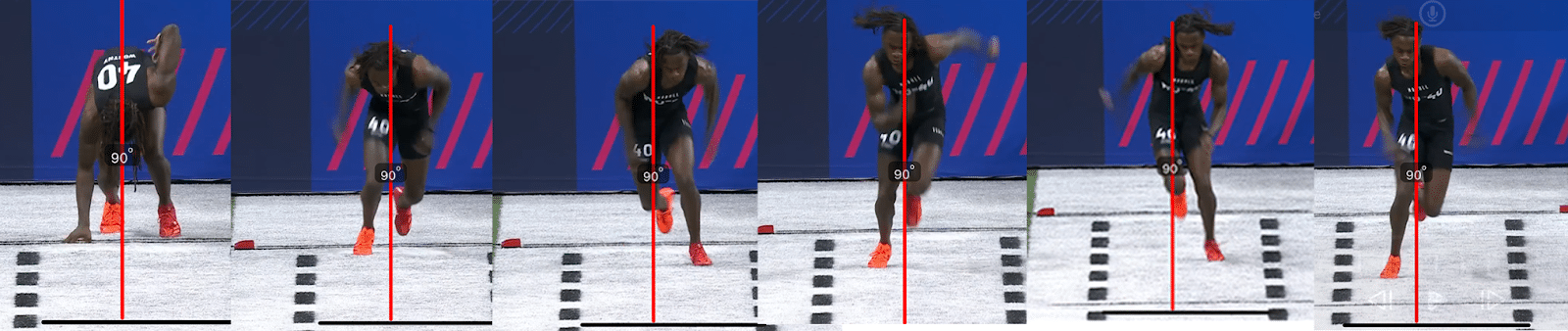
This will take some time to get used to. Some things to avoid are getting too wide with the foot where the foot is landing much wider than the head. Additionally, when accelerating the weight should be on the front part of the foot, sometimes athletes will start landing more on the heel when trying to move too much side to side. Lastly, the stride length and turnover rate which we will go over next is an important way to see how well the start is being executed.
Here are some drills I recommend to help improve the start or drive phase to improve these phases of the 40 yard dash:
- Downhill sprints
- Resisted sprints
- Resisted broad jumps
- Moving ankle jumps
- Moving tuck jumps
- Ankle/Foot ROM exercise
- Balance Exercises
- Single Leg Broad Jump
- Plyometrics
- 3 Point Stance Broad Jump
- Assisted starts
For building dynamic power and leg drive, use resistance sled or tire pulls during sprints. Performing hill sprints also enhances leg strength, stride quickness, and cardiovascular endurance.

Fixing Your Acceleration
Fixing your acceleration is critical to improving your 40 yard dash. This will make or break your ability to run a great time, so make sure you video yourself doing it and look to see what needs to be corrected. Here we will go over some areas to improve based on what you see.
Most common issue is landing angle, athletes struggle at being able to land with their heel off the ground and cannot effectively push off because of a high shin angle. Work on this by improving your foot and ankle range of motion, single leg broad jumps, assisted starts, 3 point stance start, kneeling start, etc.
Another issue people have is just not projecting forward enough during their acceleration, you can work on this with kneeling starts, falling starts or band resisted starts to assist in improving the forward motion on each step. An important thing to consider during the acceleration is how the foot leaves the ground. Overall, the less time the foot is spent off the ground the better. When practicing your acceleration there should be an emphasis on keeping the feet low to the ground to maintain great acceleration principles.
The arm swing is also key to effective acceleration. The main focus for the arms is to maintain length, especially reaching out in front, but there also needs to be a quick backward force initiated from the arms in order to have quick turnover speed. Be careful not to drop the arms too much and/or swing the arms too much side to side. The action of the arms are critical for the balance of the body and therefore the foot contact time. The more the arms are moving side to side the longer the potential foot strike in order to properly control the body. This is why many coaches will instruct athletes to maintain more straight ‘forward to back’ arm action or ‘cheek to cheek’.

We can see in the picture above the end range of Xavier Worthy’s arm motion as he is accelerating. Notice how the elbow is staying behind the shoulder. Also, when he is transitioning the arms forward and back, the hands are staying above the knees. While it is important to maintain the shoulders down during acceleration. I see some people drop the hands down too far below the knees which leads to a long arm swing. It is important to keep the arm swing quick and powerful during the acceleration.
While it is normal to have some asymmetry or difference from one side to the other, there shouldn’t be a tremendous difference. Additionally, if the arms are getting too far away from the center of the body, it is worth it to work at a slower pace to gain more control of the arm swing before advancing into top speed development. In other words, do not work on the top speed without first addressing the arm swing during acceleration if you want to run a 4.55 40 yard dash.
Transition Phase
The next part of the 40 yard dash is often overlooked but is probably the most important part of your sprinting which is the transition from the acceleration phase into top end speed. This is a process that many people mistakenly take for granted in their 40 yard dash and are not able to cover the necessary distance per step to run a great 40 yard dash time.
As you accelerate, your hips and torso should rise during the transition from acceleration to maximum velocity, maintaining proper mechanics for optimal speed. The last 20 yards of the 40 needs to be ran in 1.90 seconds in order to complete the 4.55 40 yard dash which is 21.5mph. While running 21.5mph (or faster) is not insane by any means, it is still challenging and requires the ability to cover a lot of distance per step in order to execute which means effective leg cycle and strong ground force.
The transition from the acceleration phase to the top speed phase should maintain a fast turnover rate to avoid slowing down.
Why the transition phase is so important is because of the change of force from horizontal to vertical force. While accelerating there is much more horizontal force being applied which has been proven in a variety of different studies, however the top end speed is where the largest amount of vertical force is being applied. So mastering the ability to properly accelerate will achieve high levels of top speed but being able to maintain top speed is a whole other skill.

In order to effectively transition from the drive phase to top end speed there are two areas that I queue to have the best impact on the mechanics. 1. Shorten up the arm swing, during the acceleration the arm swing is longer especially coming up and forward. To maintain good transition phase mechanics, keep the arm swing quick and the hands down rather than long and upwards. Additionally, maintain strong foot strike, as speed increases it will be easy for the hips to fall back and front side mechanics to weaken. Make sure to hard foot strike into the ground throughout the sprinting process.
This is why core stability, body awareness and overall efficiency play a critical role in running a great 40 time. If you do not know what you are doing, the chances of being successful become lower and lower. Accelerating to 21.5mph+ is about power, explosiveness, rhythm and timing while continuing to run that speed is more about positioning and body control than it is about power. Everything that is needed to run 21.5mph+ is already built in the first 20-25 yards while the last 15-20 yards is all about translating the first 20 yards into controlled speed. Achieving fast top speeds without the proper acceleration principles is the quickest way to get overuse injuries as well as inconsistent sprint times.
When at top speed there are so many critical factors at play which is why I love using the curve treadmill as a way to teach people how to get to and maintain top speed. The critical component really being how to effectively and consistently build to top speed. Then once at top speed just staying fluid and having a strategy to maintain. It’s like making a perfect painting or building a house. Everything has to be properly executed from start to finish of the art piece, once the paint has been, or foundation built, there is no turning back except by starting over. Therefore, concentration and focus is critical, you need a strategy that you can complete every time so you know you will get to your top speed when running the 40.
This is all very accomplishable though. If you remember, D.K. Metcalf raced to go the Olympics in 2021, he ended up coming in dead last in his U.S. Trials heat (not the semifinals or the finals). Now D.K. also ran the fastest 0-10 yard split in NFL Combine history so if there was someone who had a chance in the NFL to do well amongst the fastest US sprinters, he was certainly one. However, he came in dead last in just the US Trials, not a world competition which means he was not even close to making it to the Olympics. Not to take anything away from D.K. he is one of the best athletes in the NFL, but when it comes to racing in the 100m, it is a whole other level of speed that these guys are able to express. This is why I say running 4.55 is very possible for you, DK Metcalf ran the fastest 0-10 in NFL combine history but couldn’t even make it to the semi finals against people who practice their technique to perfection. The information in this book will get you to the 4.55 if you take the time to work on the technique.
Pretty much all football players have plenty of strength and power to run a great 40 yard dash time, especially if reading this book peaked your interest. So the issue is not the strength but the ability to effectively express the strength/power. This is much more challenging because it is easy to make simple mistakes that immediately limit the overall capability of running fast. The two most common are not covering enough distance per step and the other is spending too much time on the ground on each step. These two things have to be addressed when accelerating in order to have any chance of running a 4.55 40 yard dash. If you have not properly implemented the technique to run a great 20 yard dash which is to run it in under 2.8 seconds then you are not ready to move on to top speed.
Now when we get into top speed there are 8 main issues that will impact your speed. We listed them out below as well as the best video angle to see if this is happening to you.
- Crossing over (Video from back)
- Limited Foot Height/Early Foot Drop During Leg Cycle (Video from the side)
- Landing too far infront of the body (Side Video)
- Ineffective Arm Swing (Side and Back Video)
- Too Much Movement In The Spine (Side Video)
- Leg cycle too far behind (Side Video)
- Hips falling back (Side Video)
- Landing too far back in the foot/foot turned in or out (Side and Back Video)
Now many of these issues will lead to other issues in the sprinting pattern so there is really a lot to unpack for all of these and while it may be difficult to address these problems, they are the primary causes to why you are not achieving full success in your speed. So use these as a guide to address any problems you are having with your sprinting.
Crossing Over
Crossing over is when the foot simply is simply landing in the midline of the body as opposed to underneath the hip. As I have said many times before, stride length is critical to sprinting speed and many athletes simply do not run as fast because they are crossing over during their steps as opposed to landing with the foot underneath the hip. This is an issue in probably 25% of athletes so I would definitely recommend getting some video either in front or behind you to see if you fall into this category and work to fix it.

The most common fix to this is to work on exercises like reverse step ups or even lunges but emphasizing the back foot height. The back toe needs to be fully flexed or heel facing straight up during the exercise as well as during toe off. Additionally, you can work on calf raises and wall drills to emphasize pushing the knee forwards rather than twisting or pushing the knee outward as the foot is leaving the ground.
Additionally, make sure the arm swing is forward and back with the hips turning/reaching on each leg cycle. This means as the leg is in the air, the momentum of the body comes forward and out. Typically when people are crossing over, the arms are moving side to side which limits the forward momentum of the hips. Usually the hips move more side to side which causes limited range of motion in the legs and less distance per step because of crossover. As always, this is something best addressed during the start/drive phase but is easier to identify at top speed.
(Heel position during lunge)
Limited Foot Height/Early Foot Drop During Leg Cycle
Limited foot height especially when the foot is moving forward. There are all types of reasons that this may be happening but typically it is either weakness in the hip flexor/core or limited ground force during foot strike. This is a sprinting flaw that has to be trained through drills and fixed during the acceleration phase. Typically, it starts because of tight hip flexors which over time leads to weak hip flexors. Some athletes are predisposed to this issue because they have shorter legs or more flexion in the lumbar spine. If you want to run fast, make sure your hip flexors are strong!
The sprinting queue I give athletes with this issue is to push the heel up into the thigh as the leg is moving forward instead of letting the heel drop. From there, it is important to maintain toe height or point the toe upwards then aggressively strike back and down underneath the hip. This is something that will take many months of practice in order to fully fix but can certainly be done and some progress is what the goal is to then build more improvement from there.
Landing Too Far Infront Of The Body
It is common to see people who struggle with foot height to also land with their foot infront of their center of mass. Typically when this happens the athlete is also landing more towards the heel or middle part of the foot. This is a very important problem to correct but typically is an issue in athletes who struggle with top speed and will often have their foot way behind their hips at toe off. While some of the most powerful athletes suffer from this issue, their power ends up actually being a weakness because of the inability to control their speed.
The key here is to work on the ankle and the foot strike. The more the foot is able to land in a vertical position or with the toe facing downwards the better, these athletes are usually striking the ground with a more neutral foot and do not move the ankle until after foot strike. The key adjustment in the mechanics wants to be the foot needs to start moving back PRIOR to foot strike in order to make the adjustment to your running technique which leads to the biggest improvement. This should also lead to a quicker foot contact time and better angle at toe off which we will get into more later.
Ineffective Arm Swing
The next common mistake is an ineffective arm swing. The arm swing is so important when it comes to sprinting and I believe that strength in the triceps, back and biceps are critical for the development of speed. Additionally, people who have limited range of motion in their wrist will never be able to access their full sprinting potential. The wrist flick when sprinting is critical to maximize power into each arm swing while being efficient with the range of motion.
The fastest athletes are able to get into a lot of shoulder extension when running, but this is not just from having a lot of range in the shoulders but instead by having a lot of range of motion in the wrists. The arms need to be long and powerful but more importantly, quick and efficient which means they are not getting too wide or getting stuck at end ranges.

Typically athletes who struggle with their arms do not have much range of motion in their shoulders or have limited their arm swing because of inefficiencies happening in their shoulders or arms. The best way to address this is by holding small weights, I usually give people little 1 or 2lb weights to hold when they are running which typically shows them immediately the inefficiency in their arms. (The weight is used to really over emphasize the issue in the arms.) Once the issue in the arms is properly addressed it is critical to work on the arms continuously at a slower pace to create more rhythm within the sprinting technique.
The goal would be to get more length on the front side with the lower body while also adding more length on the backside within the arm swing (most people struggle with both). It is important to note here that many athletes actually cycle the legs at the same speed naturally which means that if you are around 6’0 tall you probably cycle the leg or spend the same amount of time with the foot off the ground as someone like Noah Lyles or Xavier Worthy. The difference is that they spend less time on the ground and are picking up significantly more distance per step when running. This is because of an aggressive foot strike that is started with a strong arm action and great rhythm throughout the body from the acceleration phase. If the hands are not getting behind the hips during top speed or the knees are not getting up high in the front side I would look to the arm swing in order to correct. Start with addressing the wrist and make adjustments from there depending on improvement.
Too Much Head Movement
Too much head movement forward and back at top speed. This is an important thing to consider when getting to top speed, I will see a lot of people who will start to bob their head forward and back when at top speed which can be useful when done correctly, but is mostly detrimental to speed performance. When used correctly it can help the athlete land with their foot more underneath the hip but when done incorrectly can lead to elongated foot contact times.
The primary cause for this would be weakness within the core, limited extension within the hips and or weakness in the postural support muscles such as the rhomboids. I do see some forward and back movement happening in the best sprinters in the world so i want to reiterate it is not all bad. However, I have seen many athletes who struggle to get all the way forward and upwards with their hips and instead rely on bobbing their head forward and back in order to increase their speed. This is a bit of a case to case basis as a sprinting coach watching an athlete sprint, it will probably be easier to recognize. If you are an athlete who is training on their own, you may just want to assess your video and see if an excessive amount of spine action applies to you.
LEG CYCLE
There are a lot of reasons why the leg cycle would be ineffective but most commonly it is seen with athletes who have never been taught the correct running technique and rely on ‘natural’ speed or weightroom strength. Therefore, as they are transitioning from the acceleration phase into the top end speed there is a lack of control which impacts technique. If the athlete is not able to control push off we usually see that resulting in a lack of control at top speed. The reason it is important to understand the technique is because the body positioning is everything.
The two big errors we see with the leg cycle are the foot lifting up too much rather than pushing the leg forward. While there could be a lot of speed achieved here it is inefficient and typically leads to overuse injuries in the hamstrings/groin, additionally it limits the distance per step covered. Instead of the foot lifting far behind the hip, the focus should be on getting the foot straight through, most top sprinters spend about .2 seconds with the foot in front of the hip in comparison to .13 with the foot behind.
Athletes who are lifting with the foot behind too much will have those numbers reversed and will struggle to cover any distance. To fix this I teach athletes to push off when the knee is still bent behind them instead of after it fully extends. Notice below on the right the knee is still bent during toe off and how much closer the foot is to the hip. While on the left the knee is extended at toe off which means it will take much longer for the leg to get out in front of the body, impacting overall speed capability.

The next error that will cause the foot to spend too much time behind would be the toe off angle of the foot. When the proper range of motion is not achieved in the foot, the direction of the heel will be much lower. In order to address this issue, the athlete needs to achieve more active range in the foot but should also work to get the heel up faster during foot strike. This would be achieved by getting more strength in the calf muscles, both the gastrocnemius (which is strengthened when the knee is straight) as well as the soleus (strengthened when knee is bent).
The proper foot position is critical for the leg cycle as well as achieving the proper foot strike. The more effective an athlete is at toeing off the ground, the more efficient the leg cycle will be in getting the foot to strike back down, like I mentioned earlier, the key to sprinting or running fast has to do with foot contact which is essentially three phases: foot strike, mid stance or stabilize, then toe off. When the leg is out of control going into foot strike it makes the ability to stabilize (mid stance) before toe off much more difficult and therefore longer to achieve. This is why for many people it is better to just work the leg cycle rather than working on strength, power, range of motion, etc. All those things do not matter if you are not able to effectively control the leg. Instead it is much more important to develop the correct leg cycle to better strike the ground and efficiently toe off the ground.
When the wrong part of the foot is primarily used to push off the ground it creates an improper sequence of muscle utilization throughout the system which leads to inefficiency in the leg cycle and therefore improper foot strike. This is why working on your acceleration mechanics, using video and isolating the leg cycle is critical to running a great 40 yard dash time. If the legs are not cycling right then you will not be able to build speed effectively. If you somehow overcome poor acceleration mechanics with large amounts of strength/power then the ability to sustain the speed will not be likely. Additionally, by continuing to work within a poor running mechanics model, you run the risk of overuse injuries.
Foot Strike
Effective balance and stability in the sprinting world is the ‘mid stance’ which is the little time the foot has to absorb foot strike and transition into toe off. So everything in between when the foot hits the ground until the foot leaves the ground, that is mid stance. This is arguably the most important part of sprinting because really the ability to run fast is based on how much ground force you can create. The amount of ground force you create will be directly correlated to how well you can balance and control foot strike. So having good body control and balance is a great sign for being able to run fast and also make adjustments to your running form. Static holds or balance exercises are not the only way to build balance but it is a predictor of speed and acceleration. Additionally, it is important to work just the leg cycle to make sure the foot strike is as biomechanically efficient as possible. This means the foot is striking back and with the foot in a strong position. To isolate this I usually tell people to do a single leg RDL and really focus on where their balance point is.This point wants to be the area that is striking the ground when sprinting, the smaller the area the better. Think of it like the tip of a needle, trying to strike the ground as hard as possible within that part of the foot will lead to the most amount of force and also control.
Now the next important part is foot alignment during foot strike. This is another common mistake but is also something that has so much variety, the argument can be made that no two foot strikes are the same. Mainly because we all have different points of center of balance on our feet as well as different angles and bone positions that start from our beginning infant years. While the variety is different the ultimate execution is very similar because the goal is the same (maximize ground force while minimizing foot contact time). In order to do that the foot wants to be aligned under the hip with the 2nd and 3rd toes stacked in alignment with the knee and hip. Again there are a million variations here and even from one step to the next could offer varying degrees of change but that is the goal. Not every step is going to be perfect but the athletes who can achieve this for multiple steps in a row will on average be faster than the athletes who lack the body control to properly align the foot during foot strike.
Common mistakes include striking the ground with the foot turned too far inward (inversion) or outwards (eversion). Also, landing with the foot moving forward or with limited tension will cause longer foot contact times. We will also see the foot going inwards and collapsing while striking the ground which limits force production and often leads to shin splints. Striking the ground should be a PROactive action that is planned and specific rather than REactive which is unplanned and general. If you do not have a plan for your foot strike, you are not maximizing your speed.
While many coaches and athletes make the argument that parts of sprinting are ‘natural’ or will ‘just happen’ I don’t have that philosophy. I believe the more you plan and strategize then the more you will control and therefore predict. Once you just start hoping things will ‘just happen’ there opens up the possibility of chance. This works for some people but not everyone which is why I recommend stay PROactive with your foot strike and all areas of your life.
The last mistake is allowing the hips to fall back. This is something that happens throughout sprinting, when the hips start to fall back then the ability to cover the right amount of distance becomes very challenging. For this reason having excellent core strength and hip flexor range of motion is critical to running fast.
The two reason people will end up losing hip position will either be too long of foot contact time which means the foot is cycling back behind them too much, or landing with the foot too far infront of the body. The idea is to land with the foot right underneath the hip in direct alignment with the rest of the leg. Which means it is important to get both a back and a side view of the footstrike. The side view will show if the foot is landing correctly underneath the hip frontal plane while the back view will make sure the sagittal plane is correct as well.
When working to correct someone’s sprinting I will start with the moment of foot strike and toe off to see where the glaring issues are and work from there. When the hips are too far back then you will not be able to cover the right amount of distance per step which will kill the performance of the 40 yard dash. This is a critical component of running a 4.55 40 yard dash and must be studied in order to maximize performance.
Now that we went over the basic component of the 40 yard dash I want to go more in depth into the drills and exercises that will be most important to get you to the 4.55 goal.
The drills need to be executed correctly in order to utilize the information to get the intended goal. An easy way to differentiate between fast and slow people is just watch them perform their warm up sprinting drills. People who are able to run fast simply perform their sprinting drills at a higher level. So when doing these drills make sure you are locked in and extremely focused on the execution. This can be the difference between reaching or not reaching your goal.
Exercises:


Regular stretching enhances mobility and improves range of motion, which is important for better sprinting force application.
Measuring Progress with the Timing Method
Measuring your progress is one of the most important steps in any speed training program, especially when your goal is to run a blazing 4.55 in the 40 yard dash. The timing method is a proven approach used by the fastest athletes and top coaches to track improvements, fine-tune technique, and keep you focused on the details that matter most.
Start by establishing your baseline: record your initial 40 yard dash time using a reliable timing method. This first time trial is your reference point, giving you a clear picture of where you stand and what needs work. From here, every training session and every adjustment to your sprinting technique can be measured against this starting point.
A key part of the timing method is breaking down your sprint into segments—just like at the NFL combine. Focus on the first three steps out of your three point stance, your drive phase, and your top end speed. Each of these phases can be timed and analyzed separately, allowing you to pinpoint exactly where you’re gaining or losing precious tenths of a second. For example, improving your shin angle and forward lean in your starting position can help you explode off the line with more power, while reducing ground contact time in the drive phase can help you reach maximum speed faster.
As you continue your speed training, make it a habit to regularly record your 40 yard dash times. This ongoing feedback loop is essential for tracking your progress and making data-driven decisions about your training. If you notice your times plateauing, it’s a signal to focus on specific areas—maybe your rear foot isn’t generating enough force, or your front leg isn’t driving you forward efficiently. Use video analysis to check your body position, foot strike, and arm action, and compare your form to elite NFL athletes like Chris Johnson, John Ross, or Marquise Goodwin. Studying their technique can reveal subtle adjustments that make a big difference, whether it’s a more aggressive forward lean, a sharper shin angle, or a quicker first step.
The timing method isn’t just about the stopwatch—it’s about using every split and every rep to refine your sprinting technique. For instance, if your drive phase is lagging, incorporate strength exercises like the bench press to build more power, or focus on plyometric drills to improve your ground contact time. If your top end speed isn’t where you want it, work on maintaining an upright position and maximizing your stride length without sacrificing turnover rate.
Remember, the fastest athletes in the world didn’t get there by accident—they measured, analyzed, and adjusted every detail of their training. Whether you’re a football player aiming to impress scouts at the combine, a wide receiver looking to separate from defenders, or simply an athlete chasing pure speed, the timing method is your roadmap to success. Stay focused, keep tracking your times, and use every session as an opportunity to get faster. With the right approach and relentless attention to detail, you’ll be crossing that finish line with a time that turns heads.
Stay connected with news and updates!
Join our mailing list to receive the latest news and updates from our team.
Don't worry, your information will not be shared.
We hate SPAM. We will never sell your information, for any reason.
