
Master Your Sprint Start Technique With This: A Deep Dive Into The 40 Start
Dec 05, 2025
Introduction to Sprint Start Fundamentals
The sprint start is the foundation of any explosive performance in short-distance running events such as the 40-yard dash or the 100 meters. Whether you’re an athlete aiming to improve your time or a coach looking to fine-tune your sprinters’ technique, understanding the biomechanics and timing involved in the sprint start is crucial. This post breaks down the critical elements of a high-performance start, focusing on posture, foot placement, arm drive, and ground contact times to help you maximize acceleration and reach your top speed efficiently.
Many athletes encounter common technical mistakes and biomechanical issues with sprint start mechanics, while many coaches have different perspectives and recommended techniques for arm action and stride. There is no single definitive approach, which highlights the diversity of coaching opinions and athlete experiences in sprint mechanics.
Consider this your complete guide to sprint start technique—a comprehensive, research-backed resource designed to cover every aspect you need for optimal speed development. For further authoritative information on sprinting mechanics and technique, resources published by Human Kinetics are highly recommended.
Ready for a quick start into 40? Check our FASTER 40 program with FREE e-book below or get started by filling up this form!
Why the Start Matters in Sprinting
The start in sprinting is not just about the first few steps; it sets the tone for your entire acceleration phase and ultimately your maximal velocity. A strong, technically sound start minimizes wasted energy and optimizes force production, enabling you to cover more ground quickly while using less effort.
Common errors in the sprint start can significantly impact an athlete’s ability to reach maximal velocity. Fast sprinters rely on optimal sprinting form and efficient sprinting mechanics to maximize their acceleration and minimize wasted energy.
Many sprinters make common mistakes such as leaning too far back, improper foot placement, or inefficient arm movement that reduce their potential speed.
Setting Up the Perfect Sprint Start
Proper Body Positioning
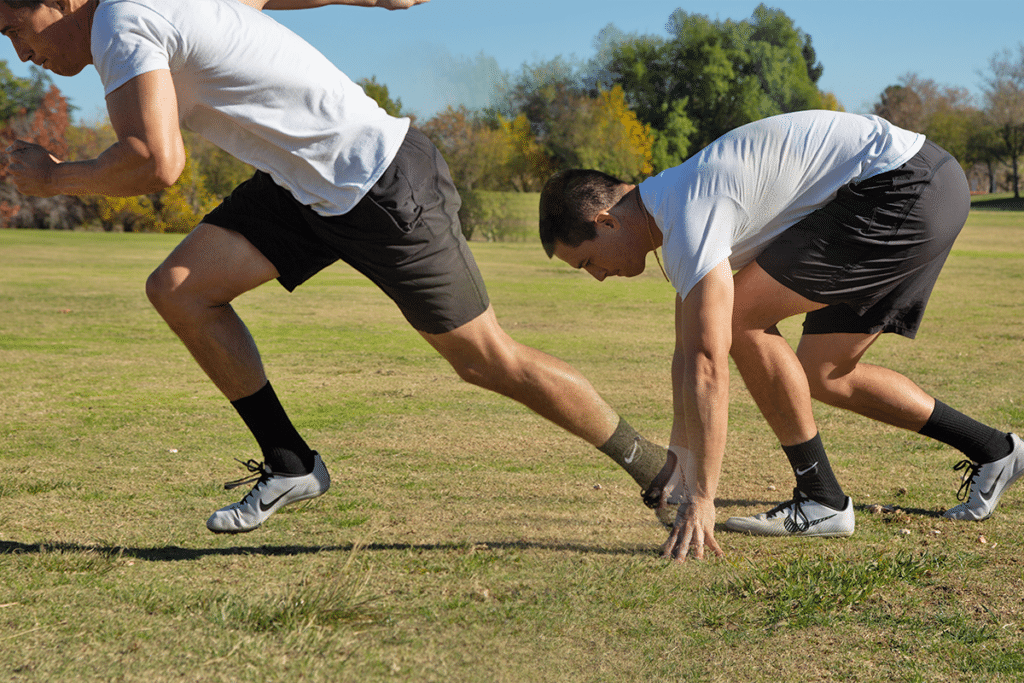
- Weight Distribution: Aim to have about 90% of your body weight on your front foot and 10% on the back foot at the start line. Make sure your weight is evenly distributed across your feet for optimal balance and explosive movement. This forward lean helps generate momentum right off the line.
- Lean Over the Line: Crowd the starting line with your head and shoulders. Avoid positioning yourself too far behind the line, as this increases the distance you need to cover.
- Hip and Head Alignment: Position the hip above the head to facilitate powerful hip drive. Maintain a proper body angle and straight alignment from head to toe. Avoid having a flat back or hips lower than the head, which can limit your acceleration.
Your starting position should set you up for a smooth transition from an initial forward lean to an upright position as you accelerate, ensuring efficient sprint mechanics throughout the movement.
Foot and Hand Placement
- Heel Position: Keep the front heel slightly elevated with the back heel even higher. The front leg (lead leg) should be positioned to generate maximal force at the start, while the back leg (rear leg) is set to extend powerfully. This setup allows you to push off explosively, with the rear foot providing a strong initial drive.
- Hand Placement: Place your thumb and index finger (or specifically the index finger) just behind or along the starting line for optimal hand positioning. This ensures proper alignment and helps maximize explosiveness at the start.
- Arm Drive: The first movement should be pulling the rear arm back while driving the opposite arm forward. Keep your elbows close and avoid flaring your arms wide, which can reduce efficiency.
- Note: If using starting blocks for a block start, ensure that your limb positioning—especially the angles of the lead leg, rear leg, and rear foot—are optimized for powerful acceleration.
Key Mechanical Principles During the First Steps
Step Timing and Ground Contact
- Time Off the Ground: Elite sprinters aim for a ground contact time under 0.25 seconds on the first step and roughly under 0.29 seconds on the second step. This quick turnover is essential for maintaining speed.
Minimizing ground contact time is a key factor in helping athletes sprint faster, as it allows for more efficient force application and improved step frequency.
- Time on the Ground: Aim for approximately 0.17 seconds of ground contact per step. Longer contact times can slow you down by reducing your step frequency.
Foot Strike Angle and Shin Position
- Landing the foot with a shin angle around 30 degrees (relative to the ground) helps generate horizontal force effectively.
- Maintaining a straight line from the back leg through the torso to the head ensures optimal force application and proper sprinting posture.
- Keep your foot landing under your hip, not out in front, to maintain balance and forward momentum.
- Maintain a high heel recovery to enable quicker and more efficient foot placement for the next step.
Common Mistakes and How to Correct Them
Overreaching and Poor Balance
- Overextending the leg too far in front increases ground contact time and disrupts your center of gravity.
- Landing with the foot far ahead of the hip causes you to “brake” and lose forward momentum.
- Correction: Focus on landing with your foot directly underneath your hip and maintaining a slight forward lean to feel like you’re “falling forward.”
Inconsistent Arm Mechanics
- Wide arm swings early in the start phase can reduce force production.
- Arms should remain close to the body with elbows at about a 90-degree angle, driving straight back and forth to complement leg movement.
Lack of Internal Rotation and Hip Drive
- Proper knee and hip rotation are essential for pushing straight through the ground.
- The knee should stay inside the foot during the drive phase to allow a strong, forward push-off.
- Imbalanced leg strength or injuries can cause twisting or lateral shifts during foot contact, reducing efficiency.
How to Measure and Track Sprint Start Performance
Using Timing Apps and Video Analysis
- Utilize apps or video tools to measure ground contact times and step intervals to identify areas for improvement.
- Key metrics to monitor:
- Time from foot leaving the ground to landing (aim under 0.25 seconds initially)
- Ground contact time (aim for approximately 0.17 seconds)
- Step length and number of steps over the first 5 yards (ideally 4 steps to cover 5 yards)
Setting Realistic Goals Based on Height and Leg Length
- Taller athletes may have slightly longer ground contact times due to leg length but should still aim to keep times within elite ranges.
- Regularly analyze your sprint start to adjust technique and improve efficiency over time.
Applying Sprint Start Fundamentals to Reach Top Speed
The goal of the start is to transition smoothly into top-end speed. This requires consistency and control in every step of the acceleration phase, with a focus on producing the maximum amount of force down into the ground during the drive phase. When starting from a stationary position, avoid the tendency to pop straight up, as this can hinder acceleration and reduce your ability to generate forward momentum.
- Five Yards in Four Steps: Elite sprinters cover five yards in about four steps, maximizing both stride length and frequency.
- Maintaining Proper Posture: Drive your hips forward and keep your chest above your hips during acceleration. The lead arm should stay close to the body and drive powerfully in sync with the legs to help propel you forward.
- Balanced Foot Placement: Avoid lateral deviations during foot strike to maintain forward momentum.
Maintain proper mechanics and speed all the way through the finish line to ensure you do not slow down prematurely and reach your full sprinting potential.
Variations and Individual Differences in Sprint Technique
- Not every sprinter will fit the “textbook” model of knee angles, shin angles, or arm drive.
- Structural differences such as leg length, flexibility, past injuries, or conditions like scoliosis can influence ideal sprint mechanics.
- It’s important to tailor technique adjustments to your unique build and strengths while adhering to key principles like efficient force application and quick ground contact.
Training Tips to Improve Your Sprint Start
Drills to Enhance Posture and Arm Drive
- Practice three-point stance starts focusing on weight distribution and hip-head alignment.
- Use resisted sprints or sled pulls to build explosive power in the first steps.
- Perform arm drive drills emphasizing a tight and controlled motion without flaring elbows.
Improving Foot Placement and Turnover Speed
- Use quick-feet ladder drills to enhance turnover.
- Practice sprint starts on different surfaces (turf, track) to adapt foot strike and contact times.
- Incorporate plyometric exercises to develop the reactive strength needed for short ground contact times.
Common Questions About Sprint Start Technique
How important is the first step in sprinting?
The first step sets the foundation for acceleration and influences stride length, frequency, and overall speed. A technically sound first step reduces wasted energy and propels you forward effectively.
Can sprint start technique vary between athletes?
Yes, individual biomechanics and physical characteristics mean that technique can vary. However, the core principles of force production, foot placement, and timing remain consistent.
How do I reduce ground contact time?
Focus on explosive strength training, quick turnover drills, and proper foot strike mechanics to minimize the time your foot spends on the ground.
The Mental and Physical Discipline Behind Speed Development
Consistency Is Key
Improving sprinting speed requires dedication and repeated practice. Developing muscle memory for ideal start mechanics and maintaining physical conditioning are essential.
Overcoming Individual Limitations
Every athlete has unique biomechanics influenced by leg length, injuries, and body structure. Flexibility in technique while maintaining core principles allows for personalized optimization.
Athletes who excel at changing direction often benefit from flexible sprint start techniques and joint mobility, which help them adapt quickly and efficiently during athletic movement.
Frequently Asked Questions (FAQ)
Q1: How important is the initial lean in sprint starts?
A: The initial lean forward places your center of gravity ahead of your base of support, facilitating a more powerful and explosive forward drive.
Q2: What is the ideal shin angle during foot contact?
A: Approximately 30 degrees from vertical, allowing for maximum horizontal force and preventing braking forces.
Q3: How can I reduce my ground contact time?
A: Focus on quick, explosive steps with proper foot placement under the hip and avoid overreaching.
Q4: Can sprinters with different body types use the same technique?
A: Core principles apply universally, but individual biomechanics may require slight adaptations to optimize performance.
Q5: How does sprint start technique differ for American football players?
A: In American football, athletes use unique starting positions based on their roles. Linemen often start in a three- or four-point stance to maximize explosive power off the line, while quarterbacks and linebackers may use a two-point stance for quicker lateral movement and agility. These positions help American football players generate rapid acceleration and adapt their sprint mechanics to the demands of gameplay.
Additional Resources
For personalized coaching, detailed video breakdowns, and sprint training programs, consider consulting specialized sprint coaches like Morey Croson at Performance Lab of California. Utilizing the weight room to develop lower-body strength is highly recommended, as it directly improves your sprint start technique and overall acceleration. Consistent feedback and tailored drills can accelerate your improvement and help you unlock your full potential on the track. For inspiration, look to elite sprinters like Usain Bolt, whose exceptional force production and sprinting ability set the standard for performance.
Conclusion
Mastering the 40-yard dash start involves a detailed understanding of biomechanics, timing, and technique. By focusing on proper weight distribution, foot placement, arm action, and step timing, you can dramatically improve your acceleration and reach top speed more efficiently. Remember, the goal is not perfection in a single area but the seamless integration of all components to generate forward momentum.
Implementing these expert insights, tracking your progress, and maintaining discipline in training will help you reach your sprinting goals. Start slow, focus on fundamentals, and accelerate your progress with consistent effort.
Stay connected with news and updates!
Join our mailing list to receive the latest news and updates from our team.
Don't worry, your information will not be shared.
We hate SPAM. We will never sell your information, for any reason.
